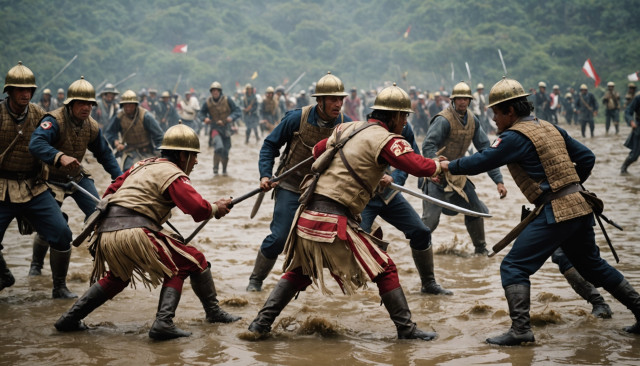
What was the Battle of Dos de Mayo?
The Battle of Dos de Mayo is one of the most glorious and significant episodes in Peru's republican history. Occurring in 1866, this battle represented the definitive consolidation of independence not only for Peru, but for all of South America, against the colonial ambitions of the Spanish crown. This heroic feat unfolded primarily in the port of Callao, where civilians and soldiers united in a staunch defense of national sovereignty against a foreign fleet seeking to regain its former influence on the continent.
For Peruvians, this date is not just a reminder of war, but a symbol of unity and sacrifice. In the school calendar, May 2nd holds a place of honor, reminding us that freedom is a value that must be protected with determination. Through this article, we will explore the details of this battle, the heroism of its protagonists, and how this commemoration remains relevant in the education and culture of our country in 2026.
Background to the conflict with Spain
To understand why this conflict occurred, we must go back to the 1860s. Spain, under the reign of Isabella II, was going through a period of expansionism and seeking to recover the prestige it had lost after the American wars of independence. The excuse for intervening in Peru was the so-called Scientific Expedition, a naval fleet that arrived on the Peruvian coast under the pretext of conducting studies, but which in reality concealed political and economic interests.
The trigger was an incident at the Talambo hacienda in Lambayeque, where an altercation broke out between Peruvian workers and Spanish colonists. This event was used by the royal commissioner Eusebio Salazar y Mazarredo to demand exorbitant reparations. When Peru refused, the Spanish fleet occupied the Chincha Islands in 1864, which at that time were the state's main source of income due to guano exports. This aggression generated a wave of national outrage that led to the overthrow of President Juan Antonio Pezet, who had signed the controversial Vivanco-Pareja Treaty, considered humiliating by the population.
The heroic role of José Gálvez Egúsquiza
To speak of May 2nd is inevitably to speak of José Gálvez Egúsquiza. As Minister of War and Navy in the government of Mariano Ignacio Prado, Gálvez assumed the responsibility of organizing the defense of Callao. Far from directing operations from the safety of an office in Lima, he decided to station himself at the heart of the danger: the Torreón de la Merced, one of the port's most exposed defensive positions.
Gálvez embodies civic courage and patriotic leadership. His presence on the battlefield boosted the morale of the soldiers and volunteers preparing for the attack. Tragically, during the heat of battle, an explosion at the Torreón de la Merced ended his life and the lives of other brave defenders. His sacrifice made him the greatest civilian hero of that day, and his name is now synonymous with total dedication to the nation. In schools, his story is told as an example that public office is, above all, a service that may demand the utmost sacrifice.
Development of the battle in Callao
On the morning of May 2, 1866, the Spanish squadron, composed of powerful armored frigates such as the Numancia, the Blanca, the Resolución, and the Villa de Madrid, positioned itself in a V-formation off the port of Callao. The attack began shortly after noon, when the Numancia fired the first shot. Callao did not back down and responded with fire from its shore batteries, strategically located along the coast.
The Peruvian defensive system boasted large-caliber cannons, such as the famous Blakely and Armstrong cannons, distributed among forts and towers like Santa Rosa and La Merced. The battle raged for over five hours. Despite the technological superiority of the Spanish fleet, the precision of the Peruvian gunners and the resilience of the land defenses inflicted serious damage on the attacking ships. The participation of the civilian population was crucial; from firefighters extinguishing the fires caused by the bombs to doctors and citizens transporting ammunition, the entire city of Callao became an impregnable fortress.
The participation of volunteer firefighters
One aspect often highlighted in historical accounts is the work of the volunteer fire departments of Callao and Lima. Amidst the hail of projectiles, these men risked their lives to prevent the port from being consumed by flames. Many of the fire departments we know today, such as Unión Chalaca, trace their origins to those acts of bravery. Their intervention not only saved property but also allowed the defense batteries to continue operating without critical interruptions.
The impact of Peruvian artillery
The Peruvian strategy relied on the use of long-range cannons that surprised the Spanish sailors. The Santa Rosa battery, located at the southern tip, and Fort Ayacucho played decisive roles. As evening fell, the Spanish squadron, with several of its ships damaged and having exhausted much of its ammunition, decided to retreat to San Lorenzo Island, thus marking Peru's tactical and moral victory.
Historical significance for Peruvian sovereignty
The victory at Callao had repercussions that transcended Peruvian borders. It signified the definitive end of any attempt by the Spanish crown to reconquer its former colonies in South America. After the battle, the Spanish fleet withdrew permanently to the Philippines, effectively acknowledging that American independence was an irreversible process. This event strengthened the sense of national identity and demonstrated that Peru, despite its internal divisions, could unite in the face of an external threat.
Furthermore, the Battle of Dos de Mayo solidified Peru's position as a beacon of freedom in the region. The alliance formed with Chile, Ecuador, and Bolivia to confront the Spanish fleet was a milestone in South American diplomacy, underscoring the importance of regional cooperation. Today, when reviewing what is celebrated in May in Peru , May 2nd stands out as the date that sealed our political autonomy.
School activities to commemorate May 2nd
In educational institutions across the country, this anniversary presents a valuable opportunity to address civic and citizenship education. Teachers can organize a variety of activities that allow students to connect with history in a dynamic and meaningful way. Some recommendations include:
- Creating mural newspapers: Students can research the biography of José Gálvez, the technology of the cannons of the time and the chronology of the battle to represent them in creative murals.
- Theatrical performances: Staging the moments before the battle or the sacrifice in the Torreón de la Merced helps students to empathize with the historical characters.
- Debates and essays: For secondary school grades, discussion topics can be proposed on the importance of guano in the conflict or the role of the Quadruple Alliance.
- Virtual or in-person visits: If the location allows, visiting the Real Felipe Fortress is an unparalleled educational experience.
These activities not only aim to convey facts, but also to foster values such as respect for heroes and an understanding of the importance of peace and sovereignty. It is ideal to integrate these themes into school projects about Peruvian culture that encompass different areas of knowledge.
Places to visit and pay homage in Lima and Callao
For families and tourists wishing to delve deeper into this history, there are several emblematic sites that keep the legacy of May 2nd alive. In Callao, the Real Felipe Fortress is the most important; there, visitors can explore the towers, see replicas of the cannons, and visit the on-site museum, which explains the defense of the port in detail. It is a place that blends colonial architecture with republican history.
In Lima, the Plaza Dos de Mayo is the most imposing civil monument dedicated to this historic event. Inaugurated in 1874, it features a marble column crowned by a bronze statue representing Victory. At the base of the column are reliefs depicting scenes from the battle and statues representing the countries of the alliance: Peru, Chile, Ecuador, and Bolivia. Visiting this plaza is an act of recognition of American unity.
Importance of the anniversary in the school civic calendar
The Peruvian Ministry of Education includes the Battle of Dos de Mayo as a mandatory date in school celebrations. This is because civic education requires solid historical references to help build the identity of future citizens. By commemorating this date, children and young people learn that the freedom they enjoy today was the result of the effort and courage of past generations.
In the current context of 2026, where technology and globalization set the standard, commemorating May 2nd allows us to reflect on sovereignty in the 21st century. It is not only about defending physical borders, but also about protecting our culture, our resources, and our capacity to make decisions as an independent nation. Therefore, the ceremonial events in schools, with the raising of the flag and the singing of the National Anthem, take on a profound meaning of renewing our commitment to the country.
The legacy of the defense of Callao today
The spirit of May 2nd is evident today in the resilience of the Peruvian people in the face of modern challenges. The organizational capacity demonstrated by the people of Callao and Lima in 1866 is the same we see today in the communities working for the development of the country. This legacy of unity is fundamental to overcoming social inequalities and strengthening democracy.
Furthermore, the history of the battle teaches us the importance of being prepared and investing in knowledge. The defense of Callao was successful not only because of the courage of its men, but also because of strategic planning and the use of the technology available at the time. This is a powerful message for new generations: patriotism is also expressed through study, innovation, and honest work for the common good. In celebrating this date, we reaffirm our pride in being Peruvian and our commitment to continue building a free and sovereign nation.