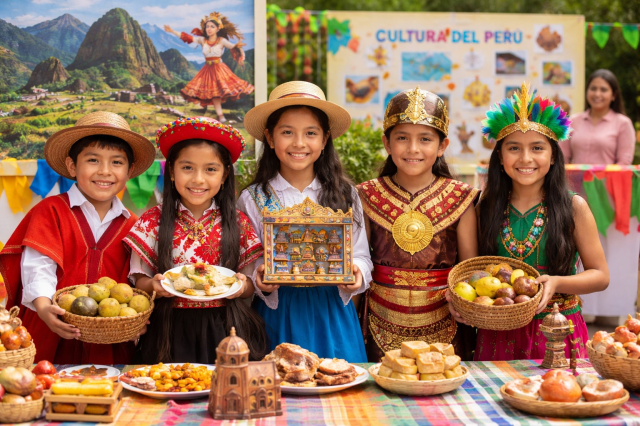
The importance of teaching Peruvian culture in the classroom
Peruvian education plays a fundamental role in preserving our traditions, customs, and values. School projects on Peruvian culture are a key tool for students to understand their identity, learn about the country's diversity, and develop pride in their roots.
In both public and private schools, these activities are integrated into the National Curriculum within the areas of Personal and Social Development, Communication, and Arts and Culture. They are also ideal for reinforcing special dates such as Peruvian Culture Day , Folklore Day , or Independence Day celebrations .
You can also check out our article on school activities based on Peruvian historical events to complement your classroom projects.
Types of cultural projects according to educational level
Projects for primary education
In primary school, projects should foster creativity, observation, and active participation. Some practical examples:
1. “My region, my pride”
Each student researches their region: its history, traditional dances, dishes, and customs. They can create murals or group presentations.
Competencies: identity and cultural appreciation.
Materials: cardboard, photos, traditional costumes, maps.
Ideal for: third to fifth grade.
2. School food fair
Students prepare traditional dishes representing different regions of Peru. Respect for diversity and culinary practices are promoted.
Skills: teamwork and oral communication.
Ideal for: all elementary school grades.
You can get inspired by our article on regional Peruvian cuisine .
3. Dances of Peru
Each class chooses a traditional dance (marinera, huayno, tuntuna, etc.) to perform at school. Students learn about the clothing, music, and cultural significance of the dance.
Skills: artistic and physical expression.
Ideal for: second through sixth grades.
Learn more about traditional Peruvian dances and their meaning .
4. “My grandpa tells stories”
Orality and cultural memory project. Children interview their grandparents or older relatives to recover old customs, songs, or stories.
Skills: oral communication and critical thinking.
Ideal for: fourth and fifth grade.
Projects for secondary education
In secondary school, projects can be more analytical and promote research, art, and social engagement.
1. Documentary: “This is how my tradition is lived”
Students produce a short audiovisual piece showcasing a local tradition (for example, the Cajamarca Carnival or the San Juan Festival).
Competencies: research, technology and artistic expression.
Ideal for: third to fifth year of secondary school.
You can get ideas from our article on regional festivals in Peru .
2. Exhibition “Textile Art of Ancestral Peru”
Interdisciplinary project on weaving techniques, natural dyes, and Andean or Amazonian symbolism. May include replicas or interviews with artisans.
Competencies: art, history and cultural appreciation.
Ideal for: first and second year of secondary school.
3. Debate: “How to preserve Peruvian culture in the digital age?”
It promotes reflection on the impact of social media, globalization, and tourism on our traditions.
Skills: argumentation and critical thinking.
Ideal for: fourth and fifth year of secondary school.
4. Living Cultures Fair
Each group represents an indigenous community of Peru (Quechua, Shipibo, Aymara, etc.) showcasing their language, art, gastronomy, and music.
Competencies: interculturality and communication.
Ideal for: all high school grades.
You may also be interested in our article on community tourism and living traditions of Peru .
How to organize a school cultural project step by step
| Stage | Description | Recommendations |
|---|---|---|
| 1. Topic Selection | Choose a Peruvian festival, dance, food, or community. | Make sure to include diverse regions (coast, mountains, and jungle). |
| 2. Research | The students gather information and testimonies. | Use reliable sources and promote family interviews. |
| 3. Product development | Create murals, presentations, models, or videos. | Prioritize recyclable materials and creativity. |
| 4. Public presentation | Classroom exhibition or cultural fair. | It encourages the participation of parents and the educational community. |
| 5. Evaluation | Final reflection on cultural learning. | Value effort, originality, and teamwork. |
Cultural projects linked to important dates
Many school projects can be related to national holidays and celebrations . Here are some useful examples:
Peruvian Culture Day (July 6): exhibition on national writers and artists.
Farmer's Day (June 24): agricultural and artisanal products fair.
National Holidays (July 28 and 29): parade of traditional costumes or historical dramatization.
Folklore Day (August 22): dance competition and exhibition of musical instruments.
Environmental Education Week (June): projects on ancestral knowledge for the care of nature.
You can consult the complete list of Peruvian school commemorations to plan the entire academic year.