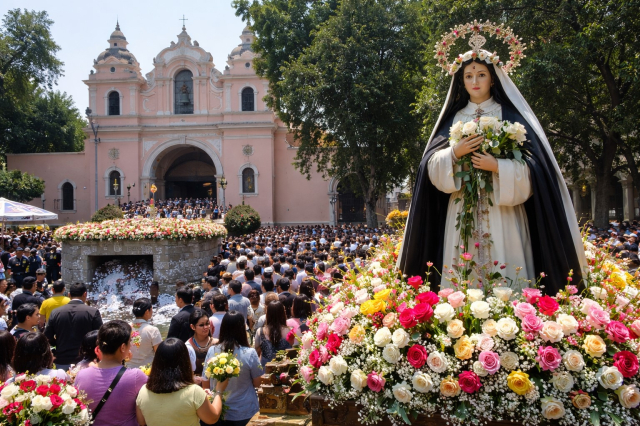
Every August 30th , Peru unites in faith and tradition to pay homage to Saint Rose of Lima , the first saint of the Americas and patron saint of Peru, the Americas, the Philippines, and the East Indies. Her feast day is one of the most important in the Peruvian religious calendar, recognized for its profound spiritual significance and for the customs that reflect the country's cultural identity.
In Lima , his hometown, thousands of faithful flock to the sanctuary that bears his name to deposit letters and petitions in the famous Wishing Well , one of the most deeply rooted traditions of the Peruvian people.
A brief history of Saint Rose of Lima
Isabel Flores de Oliva, known worldwide as Saint Rose of Lima , was born in the Peruvian capital on April 20, 1586. From a very young age, she displayed an exceptional religious vocation. She dedicated her life to prayer, helping the sick, and serving the poorest, becoming a symbol of humility and Christian devotion.
She was beatified in 1668 by Pope Clement IX and canonized in 1671 by Pope Clement X, becoming the first saint of Latin America . Since then, her figure has transcended Peruvian borders, and she is considered one of the most influential women in the religious history of the continent.
Spiritual meaning and patronage
Saint Rose is considered the patron saint of Lima, Peru, and the Americas , as well as the protector of the Peruvian National Police and nurses. Her exemplary life represents love for one's neighbor, purity, and selfless dedication.
Her life motto, “ God’s love alone is enough ,” encapsulates her profound connection to spirituality and sacrifice. In Peruvian homes, her image is a symbol of faith, hope, and strength, especially among those seeking comfort or healing.
Peruvian traditions and customs during their festival
1. The Wishing Well
Located in the Sanctuary of Saint Rose of Lima , in the historic center of the capital, this well has become the heart of popular devotion. Every August 30th, thousands of faithful deposit letters there with petitions, expressions of gratitude, or promises , seeking the saint's intercession.
2. Processions and solemn masses
In Lima and in various regions of the country, processions are held in honor of the saint. Her image, adorned with roses, travels through main streets accompanied by prayers, songs, and flowers.
The solemn masses bring together both believers and tourists interested in learning about the expressions of faith of the Peruvian people.
3. Floral altars and offerings
Flowers, especially roses , are central. They are placed on family altars, in churches, and in public spaces, symbolizing the saint's purity and spiritual devotion.
4. Celebrations in provinces
Although Lima hosts the main events, cities such as Arequipa, Cusco, Ayacucho, Trujillo and Piura also hold masses, novenas and patron saint festivities, reinforcing the sense of national unity around the Catholic faith.
Saint Rose and her legacy in Peruvian culture
Beyond the religious sphere, Saint Rose of Lima is a fundamental part of Peru's cultural identity . Her figure has inspired works of art, sculptures, poems, songs, and even the names of schools, hospitals, and streets.
In Peruvian education, his example is taught as a model of virtue and service.
Schools often organize civic-religious events , where students reenact passages from their lives and reflect on their values.
Places related to Saint Rose of Lima
| Place | Description | Location |
|---|---|---|
| Sanctuary and House of Saint Rose | Place where the Wishing Well lived and is preserved. | Downtown Lima |
| Basilica and Convent of Santo Domingo | It houses the remains of Saint Rose, Saint Martin de Porres and Saint John Macias. | Lima Cercado |
| Church of Santa Rosa de Quives | Where the saint spent part of her youth and is believed to have written her first letters. | Canta Province, Lima |
| Sanctuary of Santa Rosa in Arequipa | Pilgrimage center of southern Peru. | Arequipa |
These places are popular religious tourism destinations throughout the year, and especially on their central day, August 30.
Gastronomy and popular festivities of August 30th
During the festival, many Peruvian families gather to share traditional dishes. In Lima, Arequipa, and other cities, typical foods are prepared such as:
Rice with chicken and potatoes in Huancaína sauce
Aji de gallina
Causa limeña
Purple corn pudding and rice pudding
In some provinces, religious fairs include the sale of handicrafts, flowers, and traditional sweets. School competitions and food fairs are also held, combining faith and popular culture.
Saint Rose of Lima today
Devotion to Saint Rose remains alive in the hearts of Peruvians, despite the passage of centuries. Today, her figure inspires not only Catholic faithful, but also those who see in her a symbol of solidarity, compassion, and love for one's neighbor .
Social media and digital platforms have allowed his message to reach new generations. Every year, thousands of young people participate in pilgrimages and volunteer activities inspired by his legacy.