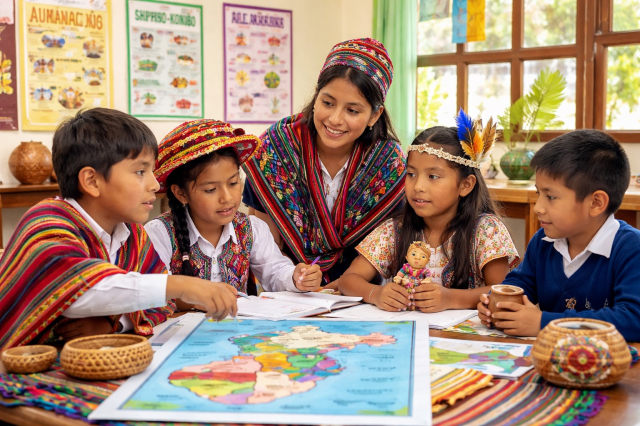
International Mother Language Day is a key date to reflect on the cultural and linguistic diversity of Peru. Our country is one of the most diverse in Latin America, with more than 40 officially recognized indigenous languages, spoken mainly in the highlands and the Amazon.
This date, promoted worldwide by UNESCO , seeks to promote respect, preservation and use of mother tongues as fundamental tools for education, identity and social inclusion.
In Peruvian schools, Mother Language Day represents a pedagogical opportunity to reinforce values such as intercultural respect, national identity and the recognition of our Andean and Amazonian roots, especially in a context where many languages are at risk of disappearing.
Mother tongues that are taught and recognized in Peru
Before developing school activities, it is important for students to know which are the mother tongues present in the country and their geographical distribution.
Main native languages of Peru
Among the most representative languages that can be addressed in the classroom are:
Quechua, with multiple regional variations
Aymara, predominant in the south of the country
Asháninka, one of the most widely spoken Amazonian languages
Shipibo-konibo
Awajún
Kukama kukamiria
This knowledge allows students to understand that Spanish is not the only language of Peru, but part of a much broader cultural richness.
School activities for Mother Language Day for primary school
Primary school activities should be dynamic, visual and participatory, promoting learning through play and cultural exploration.
Word games in indigenous languages
An effective activity is to teach basic words in Quechua, Aymara, or an Amazonian language related to the school's region. For example:
Greetings
Numbers
Colors
Animals
Students can create illustrated cards and practice in groups, reinforcing pronunciation and meaning.
Short stories in native languages
Another recommended activity is reading short stories in indigenous languages, accompanied by their Spanish translation. Afterwards, the children can:
Draw scenes from the story
To dramatize a part of history
Invent an alternate ending
This activity stimulates reading comprehension and respect for other forms of oral expression.
School activities for Mother Language Day for secondary school
In secondary school, activities can have a more reflective, investigative, and comparative focus.
Research on the native languages of Peru
Students can develop short research projects on an assigned mother tongue, addressing aspects such as:
Region where they speak
Approximate number of speakers
Current situation of the language
Associated customs
This activity can be complemented with oral presentations or informative murals.
Debate on the preservation of mother tongues
A guided discussion allows for reflection on current issues such as:
Why are some languages being lost?
What role does the school play in its preservation?
How does linguistic discrimination influence things?
This type of dynamic strengthens critical thinking and social awareness.
Intercultural activities for bilingual schools
In intercultural bilingual educational institutions, Mother Language Day takes on an even deeper meaning.
Shared classes in native language and Spanish
Teachers can develop a complete class by combining both languages, allowing students to appreciate the everyday use of their mother tongue in formal contexts.
Participation of local elders and parents
Inviting native speakers from the community to share stories, songs, or experiences in their language strengthens the bond between school and community, and reinforces cultural pride.
Crafts and visual resources for the classroom
Manual activities help to reinforce learning in a creative way.
Some practical ideas include:
Posters with words in indigenous languages
Maps of Peru showing languages by region
Illustrated dictionaries created by students
Murals with traditional phrases and greetings
These productions can be displayed in the school hallways throughout the week.
Virtual school activities for Mother Language Day
In virtual or blended learning contexts, it is also possible to develop meaningful activities.
Videos and audios in native languages
Students can record:
Greetings in an indigenous language
Traditional songs
Reading of short poems
These materials can then be shared on educational platforms or internal school networks.
Virtual forums on cultural identity
A forum allows students to reflect on their identity, share family experiences, and discuss the importance of preserving mother tongues in present-day Peru.
Educational benefits of working on Mother Language Day in the classroom
Incorporating activities for International Mother Language Day in Peruvian schools allows:
Strengthening cultural identity from an early age
Promote respect for linguistic diversity
Preventing cultural and linguistic discrimination
To value the ancestral knowledge of indigenous peoples
Furthermore, it contributes to the fulfillment of the cross-cutting approaches of the national curriculum, especially the intercultural approach.