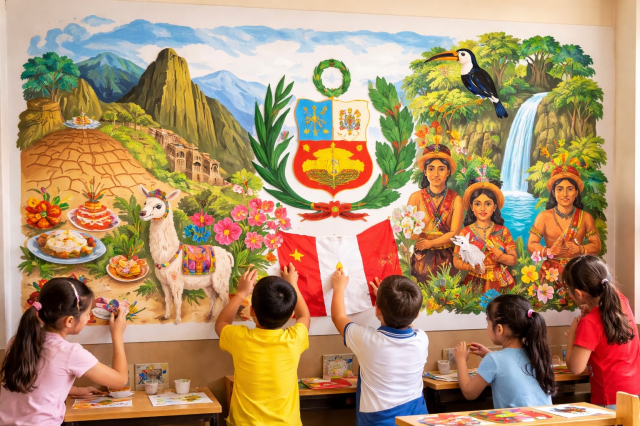
Peru is a country of immense cultural richness, where each region contributes unique traditions, dances, legends, and artistic expressions. In schools, one of the most creative ways to teach and celebrate this diversity is through school murals about Peruvian culture , which allow students to learn while expressing their identity and national pride.
The mural is not only an artistic tool, but also an educational resource that promotes teamwork, research, and the appreciation of cultural heritage.
If you're looking for ideas for your classroom, this guide will show you how to plan, design, and create a meaningful, colorful, and culturally relevant mural.
Why create school murals about Peruvian culture?
Creating murals about Peruvian culture has multiple educational benefits:
It strengthens national identity: students discover customs and figures that are part of our history.
Develop artistic skills: encourage drawing, painting and visual composition.
It promotes collaborative work: students learn to organize themselves, distribute tasks, and share ideas.
It integrates several curricular areas: art, history, communication and citizenship can be worked on in a cross-cutting manner.
Highlight important dates: themed murals can be created according to anniversaries or celebrations on the school calendar.
Steps to create a cultural school mural
1. Choose the central theme
Before starting, it's important to define the mural's theme . Some popular ideas for Peruvian schools are:
Regions of Peru: coast, highlands and jungle with their typical costumes, dances and food.
Historical figures: Túpac Amaru II, Santa Rosa de Lima, Miguel Grau or Micaela Bastidas.
Traditional festivities: National Holidays, Inti Raymi, Virgen del Carmen, Holy Week in Ayacucho.
National symbols: flag, coat of arms, anthem and representative flora and fauna.
Cultural diversity: native peoples, Quechua and Aymara languages, and artistic expressions.
2. Research and information gathering
Students should research their chosen topic , collecting relevant images, texts, and data. This can be done in groups, encouraging active participation.
Some useful sources include school books, cultural sites of the Ministry of Culture, and educational articles.
A good practice is to prepare a visual script or outline of the mural, with a title, subtitles, and decorative elements. This will help distribute the information in a balanced way.
3. Sketch and design planning
Before painting, it is advisable to make a pencil sketch on paper or cardboard.
The teacher can guide students in aspects such as:
Space distribution.
Size of figures and texts.
Use of colors representative of Peru (red, white, green, gold, blue).
Inclusion of national landscapes, characters, and symbols.
A good mural should be attractive, informative, and legible from a distance, especially if it will be located in school hallways or courtyards.
4. Recommended materials
Materials may vary depending on budget and educational level. Here is a basic list:
| Material | Main use |
|---|---|
| Cardboard or kraft paper | Base of the mural |
| Tempera paints, crayons or markers | Coloring and detailing |
| Scissors and glue | Cutting and pasting figures |
| Magazines or newspapers | Cultural collages |
| Recycled paper or cardboard | Reliefs and 3D effects |
In rural schools or schools with an environmental focus, the use of recycled materials such as bottles, caps or newspapers can be encouraged, integrating the message of environmental care.
5. Creation and decoration of the mural
Once the design is ready, the students can begin to bring the mural to life . It is recommended to divide the work into sections (text, drawing, background) to optimize time.
The teacher must monitor the coherence of the message and encourage creativity.
You can add:
Motivational phrases about the pride of being Peruvian.
Pennants or two-tone ribbons to frame the mural.
Illustrations of typical dances such as the marinera, the huayno or the diablada.
Regional scenes with landscapes such as Machu Picchu, Lake Titicaca or the Amazon.
6. Presentation and exposition
Once completed, the mural can be displayed during school activities, cultural fairs, or national celebrations.
It is also recommended to take photos and post them on the school's social media with educational descriptions and credits for the authors.
This motivates students and strengthens their sense of belonging.
School mural ideas by month
| Month | Suggested topic | Date or anniversary |
|---|---|---|
| January | Peruvian summer and landscapes of Peru | School holidays |
| February | Carnivals and regional traditions | Peruvian Carnival |
| March | Start of classes and cultural diversity | Start of the school year |
| July | National symbols and national heroes | National Holidays |
| October | Devotion to the Lord of Miracles | Lima procession |
| December | Peruvian Christmas | New Year's Eve |
Practical tips for teachers
It involves all grades, assigning tasks according to age.
Use the mural as part of an interdisciplinary project (History + Art + Communication).
It promotes dialogue on respect for cultural diversity.
Publicly acknowledge the students' efforts.
Document the process for presenting it at school fairs or competitions.
Example of a mural: “Multicultural Peru”
A mural about multicultural Peru might include:
Map of the country with typical clothing.
Timeline with historical milestones.
Famous quotes from Peruvian personalities.
Collage with typical dishes, festivals and landscapes.
This type of mural reinforces the idea that Peru is a mosaic of cultures that coexist with pride and respect.