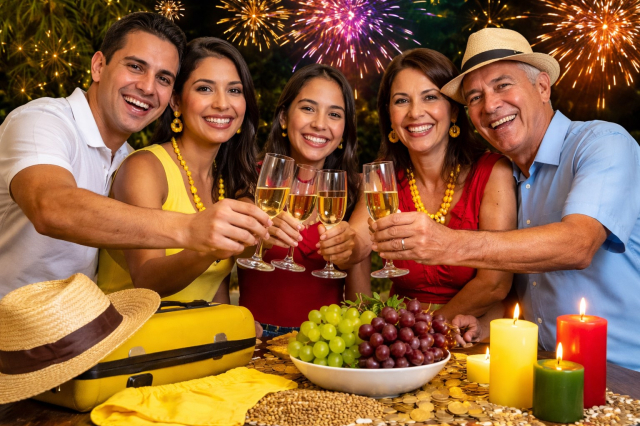
Every December 31st, Peruvian families prepare to bid farewell to the year with joy, hope, and a healthy dose of superstition. Although many of these customs have European roots, in Peru they blend with the creativity and popular faith of each region, giving rise to rituals full of symbolism.
In this article we tell you about the most curious Peruvian customs for welcoming the New Year , how they are practiced and what they mean to thousands of households from the coast to the jungle.
Eating twelve grapes to attract good luck
One of the most widespread traditions is eating twelve grapes at midnight , one for each chime and each month of the new year.
It is said that whoever manages to do it without choking will have prosperity and health. In Peru, many even make a wish with each grape , turning this moment into a small ritual of collective hope.
In some homes, the grapes are placed beforehand in a glass of sparkling wine or on the table next to the lentils, a symbol of abundance.
Wear yellow underwear to attract luck
In almost every city in the country, markets and fairs are filled with yellow underwear in the last days of December.
The color yellow represents gold and positive energy, which is why it is believed that wearing it on the 31st brings good fortune and joy .
In the provinces, many people wear this garment inside out and turn it right side out at midnight, as a sign of renewal and change.
There are also regional variations: in some places in the mountains, red is preferred, a symbol of love and passion , especially among those looking for a partner in the new year.
Walking around with an empty suitcase to attract travel
If you see someone running down the street with a suitcase right after midnight, don't be surprised: it's one of the funniest traditions of the Peruvian New Year .
It is believed that walking around the block with an empty suitcase guarantees travel and new experiences during the coming year.
Some even place a symbolic ticket or a piece of beachwear inside, reinforcing their desire to explore new destinations.
You can complement this tradition with a reading about tourist destinations in Peru that are ideal to visit in summer .
Lentils for prosperity and money
Throughout Peru, lentils are synonymous with abundance.
Many families put a handful in their pockets or prepare a special dish with them for dinner on December 31st.
The origin of this tradition comes from Italy, but in Peru it was adapted to the local style: in some Lima markets they even sell amulets with golden lentils to place in your wallet.
This custom perfectly matches the start of the new school or work year, symbolizing prosperity and economic stability.
Sweeping the house to cleanse bad energies
Another custom that cannot be missed is sweeping the whole house before or after midnight .
In many regions, this is done from the door towards the street to "expel the negative and make room for the good."
Some families complement this act with incense or Andean herbs such as rosemary and rue, which purify the environment and bring harmony.
This ritual has Andean roots, where it was believed that the home should start the year "clean" in body, mind and spirit.
Light colored candles for different wishes
Colorful candles have become a central element in many Peruvian celebrations.
Each color has a meaning:
🕯️ Yellow: money and success.
❤️ Red: love and passion.
💚 Green: health and well-being.
💙 Celeste: peace and spiritual protection.
When you light them, you make a wish while their flame represents the energy that will guide the new cycle.
In the north of the country, especially in Trujillo and Chiclayo, it is common to place a small altar with candles and flowers to give thanks for the year that is ending.
To cross midnight with money in hand
A simple but very popular tradition is to have money in your hand or in your shoe when the clock strikes twelve.
The gesture symbolizes the arrival of the new year with prosperity.
Some people keep a folded bill inside their right shoe, while others prefer to place coins under the dinner tablecloth.
Give the first hug to the person you love most.
Although it may seem like a simple gesture, the first hug of the year also has its meaning.
It is believed that the first person you hug will set the energy for your year: if it is your partner, you will strengthen love; if it is a friend, your social circle; if it is a family member, unity.
In many rural communities, this moment is accompanied by music, dancing, and a toast with chicha or local sparkling wine.
The effigy of the "old year": burning what is no longer useful
In several regions of Peru, especially on the northern coast and in the jungle, the tradition of burning the "old year" effigy remains alive.
These dolls, made of used clothes and sawdust, symbolize the sorrows, mistakes and bad experiences of the year that is ending.
At midnight they are set on fire, sometimes with fireworks or firecrackers, representing the beginning of a new cycle full of hope.