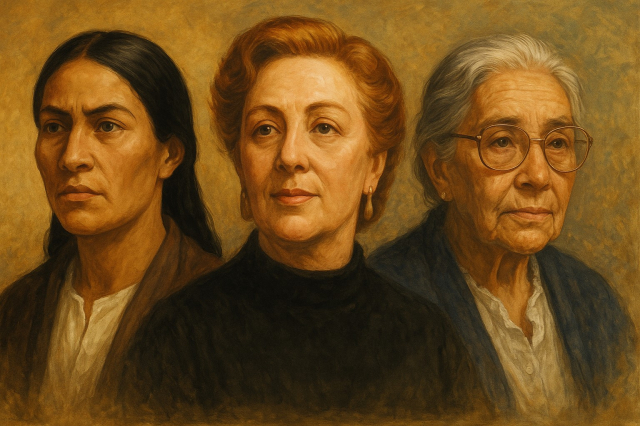
Every March 8th, the world commemorates International Women's Day , a date that invites reflection on the progress, challenges, and struggles that society still faces in achieving real equality between men and women.
In Peru , this commemoration takes on a profound meaning: to remember those women who, with effort, courage and talent, left their mark on national history, breaking social, cultural and political barriers.
International Women's Day celebrates not only individual achievements but also the collective role of Peruvian women in building the nation. From the heroines of independence to contemporary scientists and artists, each one represents an essential part of Peruvian identity.
Peruvian women who marked the history of the country
Next, we review the most influential Peruvian women from different eras, whose contributions changed the history of Peru and paved the way for new generations.
Micaela Bastidas: symbol of struggle and freedom
It is impossible to talk about the history of Peru without mentioning Micaela Bastidas , one of the bravest female figures of the 18th century.
Together with her husband, Túpac Amaru II , she led the great rebellion against Spanish rule in 1780.
Micaela was not only a comrade, but also a military strategist, administrator, and moral leader of the cause. Her vision, resolve, and love of justice made her an emblem of Indigenous and women's resistance in the country.
María Elena Moyano: voice of the people and symbol of courage
A social activist and deputy mayor of Villa El Salvador, María Elena Moyano was one of the most admired women of the 20th century.
A champion of women's and children's rights, she worked tirelessly to improve the quality of life of the most needy communities.
Her assassination in 1992, at the hands of Shining Path, transformed her into a symbol of peace, justice and commitment to the people.
Chabuca Granda: the poetic voice of Peru
María Isabel Granda Larco , better known as Chabuca Granda , brought Peruvian Creole music to international stages.
Her poetic talent and her way of portraying the essence of Lima in songs like La flor de la canela and Fina estampa made her a cultural ambassador of Peru.
Chabuca broke stereotypes in a male-dominated music world, and her legacy continues to inspire artists across the continent.
Maria Rostworowski: the historian who rewrote the past
Born in 1915, María Rostworowski de Diez Canseco dedicated her life to the study of pre-Columbian Peruvian history.
His research on coastal cultures and the Incas revolutionized the understanding of our identity.
Works such as Pachacútec, Inca founder or History of Tahuantinsuyo are academic references.
She was a woman who demonstrated that scientific research is also a field where Peruvian women can excel.
Magaly Solier: Andean talent with international recognition
Magaly Solier , an actress and singer from Ayacucho, represents the modern face of the Peruvian woman.
Her participation in films such as The Milk of Sorrow (winner of the Golden Bear in Berlin) made her a symbol of national art.
Solier has been a defender of the Quechua language and Andean culture, championing pride in our indigenous roots on international stages.
Susana Baca: the Afro-Peruvian voice of the world
Winner of several Latin Grammy Awards, Susana Baca is one of Peru's most beloved artists.
Her voice and her interpretation of Afro-Peruvian music have given visibility to a fundamental part of our cultural identity.
She was also Minister of Culture and President of the Inter-American Commission on Culture of the OAS, demonstrating that art and public administration can go hand in hand.
Contemporary Peruvian women who continue to inspire
In addition to the great historical figures, today there are thousands of women who continue to transform Peru from different fields:
Sofia Mulanovich , world surfing champion, an example of discipline and perseverance.
Pia León , recognized as one of the best chefs in the world, taking Peruvian gastronomy to new heights.
Giuliana Furci , a Peruvian-Chilean biologist who promotes the conservation of fungi in Latin America.
Verónika Mendoza , a political leader from Cusco who promotes female participation in public spaces.
These women represent the diversity and talent that characterizes Peruvian women today.
The role of Peruvian women in today's society
Peru has made progress, but still faces major challenges in gender equality .
According to the INEI, women continue to represent a high percentage of informal workers and the fight against gender violence continues.
However, more and more women are leading companies, universities, cultural institutions, and social organizations.
The fight for equality continues, and the example of the women mentioned demonstrates that change is possible.
Activities and reflections to commemorate International Women's Day
Celebrating International Women's Day in Peru can go beyond flowers or symbolic tributes. Here are some ideas that promote reflection and change:
Conduct school or university talks about Peruvian women in history.
Organize fairs for female entrepreneurship or exhibitions of art made by women.
Promote campaigns against gender violence and in favor of workplace equality.
Share local stories of inspiring women on social media.
Every gesture helps to keep alive the memory and legacy of those who have transformed the country.
A tribute that inspires us to continue changing the country
March 8th is not just a date on the calendar; it is a call to action, to respect and to equality.
Peruvian women have demonstrated throughout the centuries their ability to lead, create, research and transform.
Recognizing their contributions is recognizing our own history.
From CalendarioPeru.com , we invite all readers to value the role of women in society and to continue building a country where every Peruvian woman has the same opportunities to dream and grow.